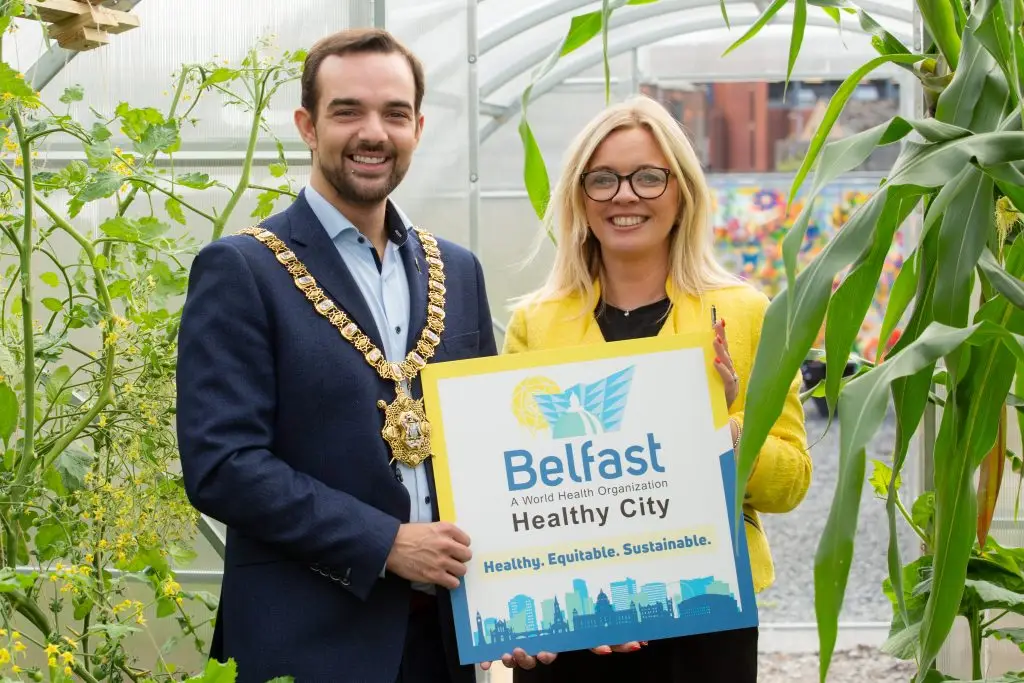
At Belfast Healthy Cities, we’ve long understood that infrastructure is not just about roads, buildings, or green spaces – it’s about people, equity, and wellbeing. As a proud member of the WHO European Healthy Cities Network for over 35 years, we are committed to ensuring that our city’s physical environment actively supports the health and potential of every citizen.
A ‘Healthy City’, as defined by the World Health Organization, is one that continually creates and improves its physical and social environments. Our work reflects that vision every day – working with communities, schools, policymakers, and partners to embed health into how Belfast grows and evolves.
May is National Walking Month, a time to promote and celebrate opportunities to walk more. Walking has so many benefits for our health and the places we work and live. Belfast Healthy Cities supported the Walking Bus pilot and was led by eight local primary schools, which acted as both planners and participants. Using our newly developed Healthy Transport Teaching Resources, children were encouraged to explore active travel, air quality, transport history, and road safety while attending their own Walking Bus. Supported by the Walking Bus Toolkit, schools engaged children in promotion of the walking bus initiative and in the importance of active travel.
Health Equity Starts with Infrastructure
We know that health is shaped by more than hospitals and doctors’ surgeries. It’s shaped by access to safe streets, green spaces, clean air, and places that enable children to play and learn outdoors. That’s why our focus on Healthy Transport and Greening the City is more than environmental – it’s also about reducing health inequalities.
Over the past year, we’ve worked closely with partners including Queen’s University Belfast and the Groundswell Consortium to roll out projects that place infrastructure at the heart of community wellbeing. Thanks to this partnership, more children have increased knowledge of the link between their health and the built environment and ten new outdoor play and learning green space projects have been funded across primary schools in the Greater Belfast area, creating safe, stimulating environments where children can thrive.
The importance of being aware of and using our green spaces
Through our Green Health Maps, we’re making it easier for communities to access and enjoy local green and blue spaces. Covering areas across North, South, East and West Belfast, these maps highlight walking routes, healthcare facilities, and key wellbeing assets, connecting people with nature and services in ways that boost both mental and physical health.
Advocating for Long-Term Change
Crucially, we are also engaging with decision-makers to ensure that health is embedded in long-term infrastructure planning. In recent months, we’ve held constructive meetings with Peter McReynolds MLA, Chair of the Active Travel All Party Group, senior officials from the Department for Infrastructure, and the Minister for Infrastructure Liz Kimmins. Together, we explored shared priorities including inclusive, climate-conscious, and age-friendly design.
Our message is clear; improving infrastructure is one of the most powerful tools we have for improving health equity. Whether it’s encouraging walking, wheeling and cycling, greening our city streets, or redesigning school grounds, each project is a step toward a healthier Belfast.
As we progress through the latter parts of the WHO Healthy Cities Phase VII, we continue to deliver on six core themes: People, Place, Participation, Prosperity, Peace, and Planet. Each represents an opportunity to create a more equitable and healthier city.
We continue our thanks to all our partners and stakeholders who share this vision and help bring it to life every day. Together, we’re working towards a Belfast where health and wellbeing are part of every policy, every space, and every decision.